Many people today are passionate about working hard whether it’s because they enjoy their work, thrive on challenges they want to overcome, or are driven by success that feels within reach. This often leads us to spend long hours seated at office desks and in front of computer screens in pursuit of our goals.
Along the way, many choose to exercise to improve physical performance, while others prefer to travel to relax and recharge before diving back into work. No matter which path you choose, one essential thing that should never be overlooked is taking care of your body especially flexibility, which is something many people tend to forget.
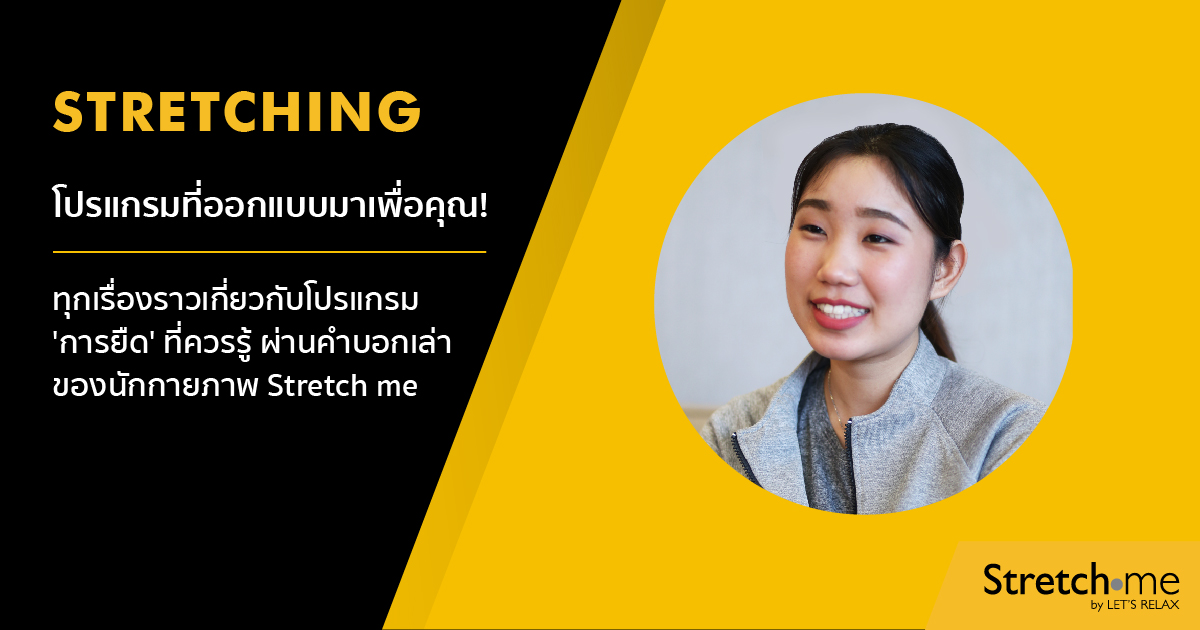
Today, we’d like to take you deeper into understanding different types of stretching, particularly the programs that Stretch Me has designed for people at risk of muscle-related issues, such as office workers, athletes, and travelers. This comes through insights into the science of stretching, shared by physical therapist Kasetaporn Aramsatjakul.
Q & A
Q: Nowadays, many people suffer from office syndrome. How can stretching help?
A: Office syndrome mainly affects people who work in offices because the nature of their work requires sitting at a desk for long periods, which means the legs remain bent most of the time. The first issue is that the muscles in those areas become tense due to a lack of stretching. The second issue is back pain from staying in the same posture repeatedly. In addition, when using a computer, if the workstation and body positioning are not properly set, it can lead to rounded shoulders and a forward head posture.
As a result, office syndrome symptoms can range from pain in the legs, back, shoulders, and neck to pain in the arms and hands for those who use their arms extensively for typing. What Stretch Me’s physical therapists do is stretch the specific muscle groups using appropriate techniques. After completing the course, we also provide recommendations to help relieve work-related aches, such as proper sitting posture and correct body alignment, which helps with long-term prevention. Once the muscles become more flexible and the person understands proper posture, various aches and pains will gradually decrease.
Q: Does Stretch Me focus stretching specifically on the areas with symptoms?
A: Yes. Stretch Me offers courses specifically designed to address office syndrome, divided into two programs: Basic Office, which is suitable for people with pain in certain areas, and Advance Office, which is for those experiencing pain or tightness in multiple areas or throughout the body. During the consultation, we ask which areas are most problematic. After stretching all major areas, we then focus more intensely on the specific problem spots.
Q: Does office syndrome take a long time to treat?
A: It depends on the severity and level of symptoms. If the condition is severe, we usually recommend stretching about 2–3 times per week for approximately one month. Once there is noticeable improvement, with less pain and better mobility, sessions can be reduced to once a week. However, regular stretching is still recommended to enhance overall physical efficiency.
Q: Aside from office workers, do athletes require different stretching methods compared to the general public?
A: For athletes, the most important thing is taking a thorough history. Physical therapists understand which muscle groups are used in each type of sport, which muscles are used more or less, and can therefore identify areas at risk of injury.
During the stretching process, athletes often need more intensive stretching than the general public. Many people think that those who exercise or play sports are more flexible, but in reality, the opposite is often true. Athletes tend to have tighter muscles because they focus primarily on contraction during training, causing the muscles to become accustomed only to shortening.
In addition, the force used during stretching and the post-stretching advice must differ. For the general public, we focus on lifestyle adjustments and posture changes. For athletes, however, we provide specific guidance on how to stretch before, during, and after their particular sport making the stretching more targeted and different from that of non-athletes.
Q: We’ve heard that Stretch Me also has programs specifically for travelers.
A: Yes. In fact, we have four specialized programs: Office Stretch, Sport Stretch, Traveler Stretch, and Ultimate Stretch. The target groups are exactly as the names suggest office workers, athletes, and travelers. The Ultimate Stretch program is designed for people with very severe symptoms, where even slight movement causes pain. This program involves a full two-hour stretching session.
The Traveler Stretch program is ideal for those who enjoy traveling or adventure activities such as rock climbing, hiking, trekking, or crossing streams, which heavily engage the leg muscles. It’s also suitable for shopping-focused travelers who experience leg pain from extensive walking.
Q: What kind of training is required to become a Stretch Me physical therapist?
A: Fundamentally, physical therapists here must have prior education in movement and muscular systems. Many of our team members graduated in public health or physical therapy and must hold a legally recognized professional physical therapy license.
After joining Stretch Me, they undergo intensive training conducted by experienced trainers with backgrounds from both overseas and hospital settings. The initial phase involves exchanging knowledge about muscles and movement to ensure everyone has the same foundational understanding.
After that, the training delves deeper into stretching techniques, the use of various tools, and customer service. The team learns together, followed by an assessment to ensure they meet Stretch Me’s standards before working with real clients.
During the examination, instructors act as clients, asking theoretical questions during the stretching session. Performance is evaluated in detail how much of the technique meets standards, accuracy of pressure point application, and overall stretching quality. The scores are then totaled, and even missing just one point means retraining until the therapist can perform perfectly.